CrowdLink: Unlocking Idle LEO Network Capacity with User Terminals¶
The Low Earth Orbit (LEO) network is booming worldwide thanks to its unprecedented number of satellites. However, most of these satellites remain underutilized to connect more users or boost performance, posing tensions for their return on investment. A critical cause is that their gateways to the Internet (ground stations) are geographically skewed or even centralized, forming last-mile bottlenecks. We examine the potential of eliminating these bottlenecks with ubiquitous user terminals (UTs). Our solution, CrowdLink, reuses UTs as local access points to decentralize satellites’ gateways to the Internet, and as relays to convert idle satellite radio links into additional paths for more network capacity. This user-centric paradigm is self-scaling to more UTs and satellites (akin to P2P networks), resilient to rapid satellite mobility, mutually beneficial for users and operators, and readily deployable in operational LEO networks. Our real tests with Starlink UTs across three countries and large-scale simulations show that CrowdLink can increase each UT’s throughput by 3.09× on average (up to 65.27×), double the LEO network capacity utilization, and unlock 2.05-7.99 million more users for Starlink without adding satellites/ground stations.
隔壁组yuanjie老师的颠覆性大作, 有幸拜读~
- 发展背景与核心痛点:
- 尽管 LEO 由于部署了空前数量的卫星而正处于全球蓬勃发展期,但大多数卫星依然未能被充分利用来连接更多用户或提升性能
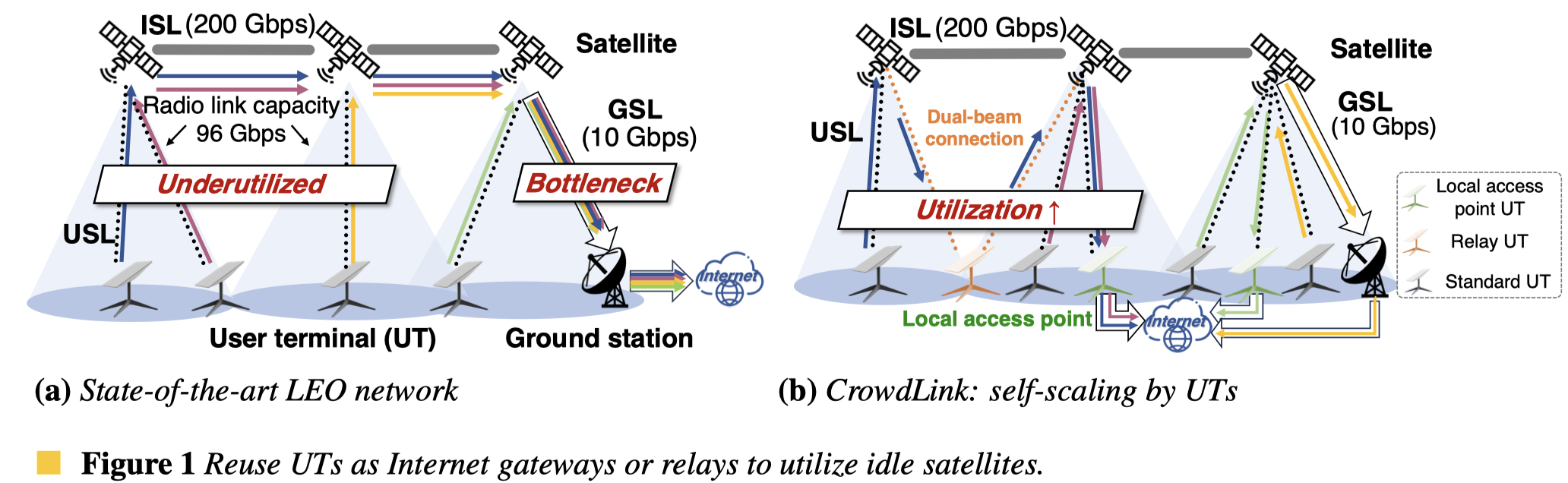
- 造成这一现象的关键原因在于: 卫星连接互联网的网关(GS)在地理分布上存在倾斜甚至过于集中,从而形成了“最后一英里”的传输瓶颈 (如 Figure 1(a) 所示的现有 LEO 网络架构中的瓶颈环节)
- 创新解决方案 (CrowdLink):
- 为解决上述瓶颈,论文探讨了利用无处不在的用户终端(UTs)的潜力
- 提出的 CrowdLink 方案将现有的 UT 重新利用:
- 一方面作为本地接入点,将卫星的互联网网关进行去中心化
- 另一方面作为中继节点,将闲置的卫星无线电链路转化为额外的传输路径,从而获取更大的网络容量(如 Figure 1(b) 所示的利用 UT 自主扩展的 CrowdLink 架构)
- 架构设计优势:
- 这种以用户为中心的新型范式类似于 P2P 网络,能够随着 UT 和卫星数量的增加实现自我扩展
- 此外,它不仅能够适应卫星的高速移动,对用户和运营商双方互利,而且可以直接部署在现今正在运行的 LEO 网络中
为什么会出现 RLC=96Gbps, GSL=10Gbps的现象? 看起来很像是 UL bw > DL bw, 很反常
初看图1确实很容易让人产生“用户上行带宽 (96Gbps) 远大于下行带宽 (10Gbps)”的错觉
产生错觉的原因是对RLC的定义不清晰, 这里梳理一下:
- RLC: 一颗卫星的"用户侧总接入容量" ("我最多可以撑下多少")
- "这颗卫星通过先进的相控阵天线, 能同时处理的所有用户上下行流量的总和"
- GSL: 卫星与GS之间的馈电链路容量 ("链路带宽")
- 这就是我们一般意义上理解的 GSL Bandwidth
因此这里想表达的真实含义是:
卫星在太空中的硬件能力非常强大,理论上可以同时承载 96 Gbps 的用户流量! 但是,由于连接卫星与地面互联网骨干网的"数据管道"(GSL)仅有 10 Gbps ,成千上万的用户必须去抢占这极度有限的 10 Gbps 落地带宽...
Introduction¶
We are witnessing a boom in satellite Internet service. Low Earth Orbit (LEO) mega-constellations, such as Starlink, OneWeb, and Guowang, have deployed an unprecedented number of satellites to connect numerous users from rural, maritime, aviation, and other remote areas for Internet access everywhere, anytime. More LEO satellites are also planned to launch in the hope of expanding network capability for more customers and better performance.
However, this resource-intensive LEO network expansion has been increasingly questioned on its return on investment. Despite the noticeably decreased cost of manufacturing and launching each LEO satellite, the upfront cost for the entire mega-constellation with numerous LEO satellites remains prohibitive. Unless the LEO satellite mega-constellation can be efficiently utilized to serve enough customers, it would be tough for it to cover its cost for a breakeven (which is indeed the case for most LEO network operators today [31, 59, 58]).
Unfortunately, the current satellite network architecture hampers the full utilization of the LEO mega-constellation. As illustrated in Figure 1a, to provide Internet access, the LEO satellites need to connect to a terrestrial gateway (e.g., ground station) through either their local radio links or intersatellite routes. In reality, the distribution of ground stations is more skewed and centralized than LEO satellites due to geographic/policy constraints, uneven demands for service, and prohibitive costs. On the one hand, these centralized ground stations become the last-mile bottleneck to throttle the overall LEO network capacity. On the other hand, most LEO satellites in motion are out of these ground stations’ visibility, leaving their ultrahigh-capacity radio beams and laser crosslinks severely underutilized.
To eliminate this waste of satellites, an obvious solution is to decentralize the ground stations worldwide to avoid the last-mile bottlenecks. This method is impractical for at least two reasons. First, building such a global infrastructure is expensive. To fully utilize satellite links, each ground station requires dedicated phased array antennas, radio processing units, and fibers for broadband connectivity, leading to an upfront cost of $1.25 million for just one Starlink community gateway [67]. The operators simply cannot afford to deploy a vast number of such ground stations for widearea coverage. Second, ground stations cannot be deployed everywhere due to geographic constraints (e.g., in oceans that cover over 70% of the Earth) or policy reasons. This coverage blackhole can leave more than 70% LEO satellites still idle.
Instead, we study a complementary paradigm: repurpose user terminals as satellites’ Internet gateways and relays. Compared to ground stations, satellite user terminals (UTs) are much cheaper (e.g., $89–$499 for each Starlink dish [1]) and more ubiquitously distributed worldwide at scale (e.g., over 7 million Starlink users from 150 countries, oceans, and aviation areas [64]). As shown in Figure 1b, they have built-in Ethernet ports to connect wired networks as local Internet gateways. Their antennas can also generate multiple beams to connect different satellites [2, 10, 50, 55, 28] to complement inter-satellite links for more capacity. While each UT’s bandwidth is small, the aggregation of numerous UTs can result in a comparable bandwidth to dedicated ground stations. More importantly, this paradigm is self-scaling by nature (similar to P2P networks): more UTs can help themselves for more bandwidth and shorter path delays, while enabling the satellite operator to activate otherwise wasted satellite capacity and improve utilization at low cost.
Despite its appeal, this paradigm still confronts challenges from network scale and satellite mobility. Its numerous UT-based gateways/relays may inflate the network topology and complicate the satellite routing. This issue is exacerbated by the extreme mobility of LEO satellites. In addition, the fast-moving LEO satellites continually change their connectivity to different UT-based gateways/relays on a global scale. This implies frequent route reconfigurations that may downgrade network availability, efficacy, and reliability.
Our solution, CrowdLink, addresses these concerns with a simple UT-centric design. It leverages the fact that, compared to LEO satellites, most UTs can be viewed as almost stationary 1 . The topological relations between UTs are hence stable as well despite satellite mobility. To this end, CrowdLink builds its routing and data forwarding over this stable UT mesh to mask the LEO dynamics for stable, scalable, and efficient networking. It instructs each UT to discover its upstream relay UT by geography, stabilizes each relay link by sharing the satellite schedules between neighboring UTs, constructs the data path to UT-based gateways by recursion, and incentivizes UTs to participate and forward data with built-in rewards. To ease incremental deployability, CrowdLink can realize all these features with readily-available modules in commodity UTs and operational LEO networks.
We have prototyped CrowdLink using Starlink UTs in a non-intrusive way and evaluated it with real-world experiments across three countries and large-scale simulations. Our results show that, without adding satellites or ground stations, CrowdLink can increase each UT’s throughput by 3.09× (up to 65.27×), double the LEO network capacity utilization, and unlock additional 2.05-7.99 million serviceable users for Starlink.
(1) LEO网络的发展与投资回报压力:
低轨卫星网络虽然正处于蓬勃发展阶段,但由于整个大型星座的前期建设成本极为高昂,其投资回报率日益受到质疑
除非网络能被高效利用以服务足够多的客户,否则很难实现盈亏平衡
(2) 当前架构的“最后一英里”瓶颈:
现有的卫星网络需要通过地面站接入互联网,但由于成本和地理限制,地面站的分布极不均衡且高度集中(如 Figure 1a 所示)
这不仅导致地面站成为限制整体网络容量的传输瓶颈,还使得大量处于运动中且超出地面站覆盖范围的卫星,其高容量的无线电波束和激光交叉链路被严重闲置
(3) 传统扩建方案的局限性:
试图通过在全球范围内去中心化、大规模部署地面站来解决该问题是不切实际的:
- 部署成本过于高昂: 例如单个 Starlink 社区网关的前期成本就高达 125 万美元
- 另一方面,受限于地理环境(如占据地球超过70%面积的海洋)和政策约束,很多区域根本无法建设地面站
(4) 将 UT 作为网关与中继的新思路:
论文提出了一种互补的新范式, 即: "将无处不在的廉价用户终端(UT)重新用作互联网的本地网关和卫星中继"
如 Figure 1b 所示! 这种方案类似 P2P 网络,具备天然的自我扩展能力,能够通过聚合大量 UT 的带宽来激活闲置的卫星容量,同时为用户提供更多带宽和更低的延迟
(5) 实施挑战与 CrowdLink 的解决机制:
Challenges: 引入海量 UT 作为网关/中继会使得网络拓扑极度膨胀,而 LEO 卫星的高速移动又会导致路由频繁重构,从而影响网络的可用性与稳定性
Solutions: 对此,CrowdLink 利用 UT 相对静止的特点,在一个稳定的 UT 网格上构建路由以掩盖卫星的动态变化!
系统通过地理位置发现上游节点、同步卫星调度时间表来稳定链路,并引入内置激励机制鼓励用户参与,该方案可直接在现有商用 LEO 网络中部署
Note
(1) 核心问题: GS极少且分布不均, 形成星座容量的bottleneck; 如果直接"规模化"成本过高
(2) 解决方式: 把UT拉进来, 让UT作为 local access point
(3) 解决遇到的challenges: UT太多, 网络规模急剧扩张; 且LEO高度动态不稳定 -> 网络规模大、稳定性差
(4) 聪明的design: UT 静止 -> 构建静态的UT mesh -> routing等网络行为基于此"静态"网络
Motivation¶
This section measures the severe underutilization of LEO networks, analyzes the limitations of related work to address this issue, and motivates the use of UTs in our solution.
2.1 Idle Satellites in LEO Networks¶
LEO networks have expanded at an unprecedented pace in recent years. Due to each satellite’s finite link capacity and coverage, most LEO networks tend to deploy more satellites for higher capacity, fewer coverage holes, and hence more customers and revenue. As of September 2025, there have been over 11,856 LEO satellites in orbit [14], leaving fewer orbital slots to host more satellites. Such an orbital resource scarcity has further spurred the race of satellite deployments among LEO network operators, with up to 42,000 satellites to launch by Starlink [35, 36, 38], 3,232 by Amazon Kuiper [34, 37], and 13,000 by Guowang [15, 16].
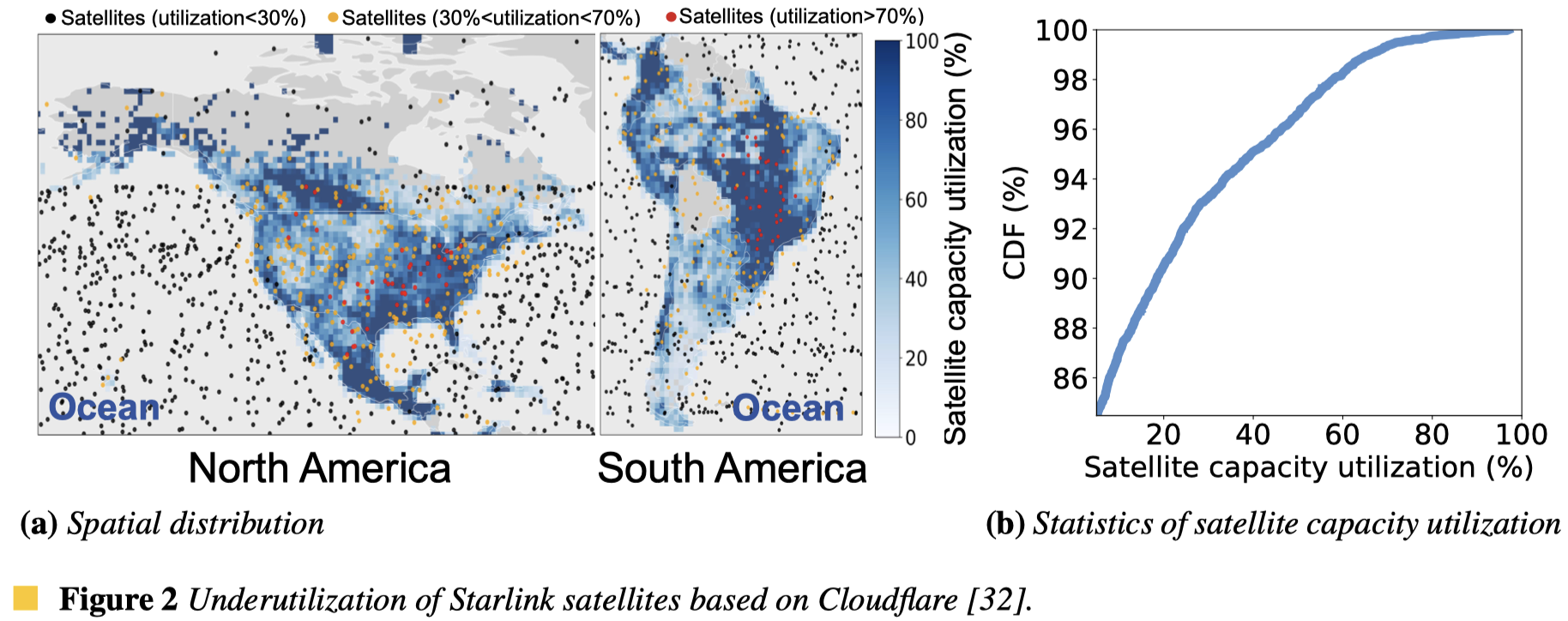
Despite this crazy space race, most LEO satellites in orbit remain severely underutilized. Consider Starlink, the largest operational LEO network to date, with more than 7 million customers from 150 countries. With a 96-Gbps radio link to users and 3 laser inter-satellite links for each Starlink-v2 mini satellite [9], its overall network capacity has exceeded 450 Tbps [65]. However, according to Cloudflare’s traffic measurements for Starlink [32], more than 90% of its satellites’ bandwidth utilization is less than 20%, as illustrated in Figure 2b. Even in hotspots like New York, up to 26.6% of satellite capacity goes unused (Figure 2a). In low-demand areas (e.g., oceans), this number approximates 100%.
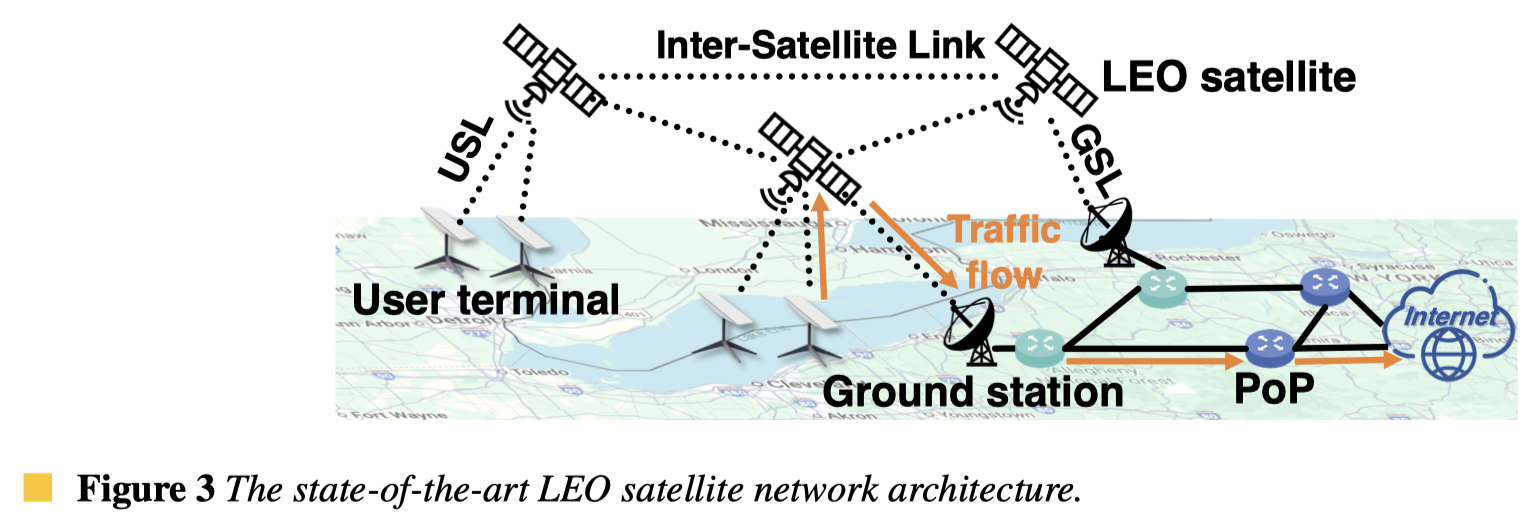
A main cause of this severe underutilization of satellites is their reliance on terrestrial gateways (ground stations) for Internet access. As illustrated in Figure 3, UTs’ traffic is first uplinked to satellites, optionally forwarded through inter-satellite links (ISLs), then downlinked to ground stations (GSs), and finally delivered to Internet via terrestrial points of presence (PoPs). However, large-scale GS deployment is capital-intensive and geographically constrained. For instance, Starlink currently operates only 227 ground stations and 46 PoPs globally [22], with most GSs centralized in few regions (Figure 4). In contrast, satellites are uniformly distributed over the globe. This spatial imbalance and scale asymmetry create a chokepoint: thousands of satellites must share access to a limited number of GSs. This results in the ground-to-satellite link (GSL) bottleneck, which limits per-UT throughput and reduces satellite utilization. Moreover, GSL bandwidth (10 Gbps [3, 4, 19]) is significantly lower than ISL bandwidth (200 Gbps [24, 9]), exacerbating GSLs as the dominant capacity bottleneck in the system.
低轨卫星网络存在严重闲置与“星地链路”瓶颈
资源严重闲置:尽管 LEO 卫星网络扩张迅速,但其实际利用率极低。例如,Starlink 超过 90% 的卫星带宽利用率不足 20%,偏远海洋地区近乎 100% 闲置,甚至在纽约等热点地区也有高达 26.6% 的容量未被使用(如 Figure 2a 和 Figure 2b 所示)
根本原因:目前的网络流量严重依赖地面站 (GS) 作为互联网网关(如 Figure 3 的流量路径所示)。然而,卫星分布是全球均匀的,而地面站数量极少且分布高度集中(如 Figure 4 所示),这种不对称性导致了星地链路 (GSL) 瓶颈,极大地限制了吞吐量和卫星利用率。
2.2 Limitations of Related Work¶
To mitigate the above waste of satellites in LEO networks, the community has explored three categories of clean-slate designs or practical workarounds:
Expanding ground stations: A natural approach to alleviate GSL bottlenecks is to increase the number of ground stations and deploy them more widely. A denser GS deployment provides more landing opportunities for satellites, activating more GSLs, thereby increasing the utilization of idle satellite capacity. However, this approach encounters three challenges:
(1) Geographic and policy constraints: GS deployment is primarily limited to land, which accounts for less than 30% of Earth’s surface. Even on land, many regions like rainforests, deserts, and mountainous areas can not easily support GS deployment [61]. Furthermore, geopolitical restrictions make it difficult to obtain the necessary permissions for GS installation, particularly in foreign or sensitive territories [57].
(2) High deployment cost: Large-scale GS expansion incurs substantial economic overhead. The number of GSs must scale with the number of subscribers, leading to escalating costs, including site acquisition, construction, operational, and maintenance cost. For example, the Starlink community gateway incurs a recurring cost of $75,000 per Gbps per month, with a one-time setup fee of $1.25 million [67]. Similarly, deploying a single OneWeb ground station costs an estimated $15 million, excluding operational and maintenance expenses [5]. As illustrated in Figure 6a, achieving just 11.23% satellite utilization improvement would require building an additional 795 GSs at a cost of 993.7511,925 million USD, which would result in a low return on investment. Although it is possible to build cheaper ground stations [63], it is usually at the cost of limited bandwidth and hence falls short to eliminating the last-mile bottleneck.
(3) Inflexible: Fixed GSs are inherently inflexible and cannot adapt to dynamic changes in user density and traffic demand. In practice, to meet peak demand, operators may oversupply GS capacity, which can reduce cost-efficiency during off-peak periods. [40, 13, 20, 17] suggest dynamically leasing GS capacity from third-party providers based on traffic demand, aiming to improve flexibility and reduce upfront deployment costs. However, this approach still faces two major limitations. First, the global GS pool remains small compared to the number of active satellites, and hundreds of thousands of satellites still compete for connections to only a few hundred GSs, leaving the fundamental bottleneck unresolved. Second, most GS providers [13, 20, 17] require satellite operators to reserve usage windows several hours in advance, which limits the system’s responsiveness to short-term demand shifts.
Exploiting inter-satellite links: Alternatively, recent efforts seek to leverage ISLs to use idle satellites. These efforts typically involve designing inter-satellite topologies and load-balancing strategies to distribute user traffic more evenly across satellites and ground stations. As shown in Figure 5, ground station load is often imbalanced. Some GSs are heavily congested while others remain underutilized. By spreading traffic across multiple GSs, load balancing can improve per-UT bandwidth. Meanwhile, routing traffic through underutilized satellites helps increase satellite utilization.
While helpful, ISLs alone cannot eliminate last-mile GSL bottlenecks. When the dominant bottleneck is the aggregate GSL capacity, ISLs merely reshuffle where traffic lands and cannot increase the total throughput. Take Starlink as an example: with 227 GSs, each equipped with eight 20 Gbps Ka-band antennas, the system offers a total downlink capacity of 36.3 Tbps. When shared by 4.6 million users, the average per-user capacity remains just 7.9 Mbps. Figure 6b illustrates the effect of ISL activation ratio on utilization. Assuming each satellite has no more than two intra-orbit ISLs and no more than one inter-orbit ISL, we simulate different ISL activation ratios. While utilization improves with more active ISLs, the overall gain is limited. Even at full ISL activation, the improvement is only 5.9%, which is far from sufficient.
In addition, ISLs remain operationally constrained in today’s LEO networks. Establishing a laser ISL involves scanning, acquisition, tracking, and pointing, which can take hundreds of milliseconds [27, 66, 29]. Once connected, satellites must continuously adjust their orientation to maintain the connection. As shown in Table 1, ISL maintenance requires extremely tight angular alignment. Even small orbital jitter or line-of-sight disruptions can break the link. Hence, in operational LEO networks like Starlink, multi-hop ISL routing is mostly used for users outside the GS coverage [6].
Redesigning the LEO constellation: Since neither of the above workarounds can eliminate bottlenecks from skewed ground stations, it is interesting to consider whether one can totally redesign the LEO constellation to avoid satellite waste. In this direction, [45, 30] design non-uniform LEO constellations to match the satellite supplies with the uneven terrestrial demands. [53, 54, 48] advocate multi-operator LEO constellations to increase their satellite utilization. While inspiring for future LEO networks, these clean-slate constellation designs are difficult to retrofit into operational LEO networks today to utilize their massive idle satellites.
现有解决方案的局限性
[1] 扩建地面站的不可行性:增加地面站面临三大挑战!
- 地理与政策限制 (地面站基本只能建在占地球表面不足30%的陆地上)
- 成本极其高昂,例如仅提升 11.23% 的利用率就需要耗资近 10 亿美元(如 Figure 6a 所示)
- 固定基站缺乏灵活性,难以应对动态流量
Note
这一部分可以积累!
很多潜在的工作都想做:GS如何分布?GS如何规模化
因此这里的提及“GS规模化的问题”未来或许可以复用!
[2] 星间链路 (ISL) 的局限性
虽然利用星间链路可以平衡不同地面站之间的负载(如 Figure 5 所示),但它无法解决系统总容量(GSL)不足的根本瓶颈
即使全面激活 ISL,利用率也仅能提升 5.9%(如 Figure 6b 所示)
此外,激光链路的对准和维护在实际操作中极为苛刻(如 Table 1 所示)
[3] 重构星座设计:
虽然学术界有"非均匀分布"等全新星座设计方案,但这些方案难以向后兼容,无法直接部署到现有的商业 LEO 网络中
2.3 Opportunity: UTs as Ubiquitous Sidelinks¶
We unveil a new opportunity to unlock the LEO satellites’ idle radio link capacity using ideas from P2P networks: reuse UTs as ubiquitous side-links for satellites. To date, modern satellite UTs are no longer dumb receivers. As summarized in Table 2, they are equipped with phased array antennas for high-speed data links (which can form multiple beams for multi-satellite connectivity [50, 55, 28]), LAN interfaces to connect terrestrial networks, and over-the-air (OTA) firmware upgrades for various software-defined functions. These new features make UTs capable of playing two additional roles:
UT as a local access point (gateway): Each UT can act as a lightweight, user-operated “mini ground station/PoP” by connecting to the terrestrial Internet via Ethernet, Wi-Fi, or other interfaces. Nearby UTs can reach the Internet through this UT gateway, providing an additional landing path when ground stations are congested or far away.
UT as a relay node: If connected to multiple satellites using different radio beams, each UT can act as a relay between them. This side link can complement ISLs to increase capacity. It can also form hop-by-hop UT relay paths to extend the service coverage of the above UT-based local access points 2 .
By offloading traffic to these underutilized UT-Satellite links (USLs), this paradigm can utilize otherwise wasted satellite-to-ground capacity, increase each UT’s bandwidth, shorten its path delay, and improve the utilization of satellites to host more users. Compared to solutions in §2.2, it is more scalable and practical for four reasons:
1. UTs are ubiquitous: Unlike dedicated ground stations, UTs can be deployed wherever users reside or operate, including on oceans, islands, deserts, and mountainous regions. There have been more than 7 million Starlink UTs from 150 countries [64], with over 75,000 of them installed on ships worldwide [9]. This naturally forms a dense and flexible wide-area fabric of Internet access and relays, even in regions where ground stations are impractical to deploy. While each UT contributes limited bandwidth, the aggregation of massive UTs can proliferate bandwidth comparable to dedicated ground stations.
2. UTs are cheap: The above dense UTs are 3-4 orders of magnitude cheaper than dedicated ground stations and readily available, making them a cost-effective complement to state-of-the-art ground station networks.
3. UTs are easy to upgrade: Modern UTs already lay a solid foundation to incrementally deploy this paradigm, as shown in Table 2. For instance, Starlink Dishy already maintains a backup beam for inter-satellite soft handovers [2, 10, 28], which can be repurposed to maintain multisatellite connectivities. In this way, the UT can act as an inter-satellite relay and complement ISLs for more bandwidth.
4. Most UTs are stationary: Compared to LEO satellites at about 27,000 km/h, the UT motions are negligible, making the overall UT relay/gateway fabric close to a fixed network. As we will see, this feature is especially helpful in scaling and simplifying the networking.
新机遇:将用户终端 (UT) 转化为无处不在的侧边链路
现代商用 UT 已经不再是单纯的接收器,它们配备了相控阵天线、局域网接口以及 OTA 固件升级能力 (如 Table 2 所示)
基于此,论文认为UT在场景下能够胜任"两种"新角色:
- 本地接入点(网关):UT 通过以太网/Wi-Fi 连接本地有线网络,化身为微型地面站
- 中继节点:UT 利用多波束连接多颗卫星,作为星间链路的补充
该范式的四大核心优势:
- 无处不在:UT 随用户分布在全球各地(甚至海洋),海量 UT 聚合起来的带宽媲美大型地面站
- 成本低廉:UT 的设备成本比专用地面站便宜 3-4 个数量级
- 易于升级:利用现有硬件能力,通过软件层面的升级即可实现新功能
- 相对静止:相比于以 27,000 km/h 高速飞行的卫星,UT 在拓扑结构中几乎是固定的,这极大地简化了大规模网络路由和管理的难度
Solution Overview¶
We propose CrowdLink, a user-centric scheme based on the vision in §2.3 to unlock the idle capacity in operational LEO networks. Although appealing, it is non-trivial to fulfill this vision due to various challenges for functionality, scalability, and sustainability. We discuss these challenges in §3.1 and present CrowdLink’s design principles to address them in §3.2.
3.1 Challenges¶
While UTs are already ubiquitously available and technically capable of leveraging satellites’ idle capacity, they still confront three challenges to fulfill their potential:
C1. Making it work: incremental deployment with minimal changes. We target a readily deployable design for today’s operational LEO networks. This constrains the solution space. Since satellites are harder to upgrade, the design should require no changes to satellites. Moreover, since current satellites assume ground stations as the only egress points, a key challenge is to integrate UT-based egress and relaying into the current framework while keeping the satellite side transparent. At the same time, given the scale of existing deployments, casting UTs as relays or local access points should not require hardware replacement.
C2. Making it work well: scalability under UT scale and LEO mobility. The scale of the LEO network will considerably inflate after incorporating numerous UT-based gateways and relays. Different from the state-of-the-art LEO networks, now the UTs are no longer end hosts only; they become part of the forwarding infrastructure and must be considered in routing and data forwarding at the scale of millions. More seriously, all these incorporated UTs’ links are intermittent due to LEO mobility. At the speed of 27,000 km/h, each LEO satellite can cover each UT for 3–10 minutes, after which the UT must hand over to another satellite to maintain connectivity. This results in tons of USL changes per second over this large-scale LEO network topology, thereby significantly challenging the scalability, efficiency, and reliability of routing and data forwarding.
C3. Making it work well continuously: incentives for UT participation. Unlike ground stations that are fully provisioned and managed by the network operators, UTs are privately owned and operated. While C1 and C2 highlight the feasibility and scalability challenges of enabling UTs as relay or breakout nodes, a further challenge lies in their willingness to participate. Providing such services is not free: a local breakout UT must contribute its own backhaul capacity and pay for Internet access and electricity, while a relay UT consumes additional device power and reduces its own usable capacity. Without incentives, participation may be insufficient. If incentives are misaligned or absent, the system risks either insufficient participation or opportunistic misuse. A practical design must incorporate an incentive mechanism that sustains continuous participation and adapts to spatial and temporal demand variations.
落实愿景面临的三大挑战
- C1. 部署可行性(如何以最小改动增量部署)
- 卫星在轨升级极其困难,因此系统必须对卫星端保持完全透明(即卫星依旧认为自己在和传统地面站通信)
- 同时,在现有的庞大规模下,要求用户更换 UT 硬件是不切实际的
- C2. 扩展性与稳定性(如何应对海量 UT 与卫星高速移动)
- 一旦数以百万计的 UT 从单纯的终端变为路由转发节点,网络拓扑将急剧膨胀
- 更严重的是,LEO 卫星移动极快(约 27,000 公里/小时),每颗卫星覆盖单个 UT 的时间仅有 3-10 分钟
- 这种频繁的链路切换会引发海量的路由重构,严重威胁网络的效率与可靠性
- C3. 长期可持续性(如何激励用户持续参与)
- UT 是私人拥有的设备。作为网关或中继节点,用户不仅需要消耗自己的回传带宽、互联网接入费用,还会增加设备功耗并占用自身的可用容量
- 如果没有合理的激励机制,系统将面临参与度不足或被恶意滥用的风险
3.2 Key Ideas of CrowdLink¶
To address the challenges in §3.1, CrowdLink follows three design principles:
(1) Reuse existing network functions whenever possible: CrowdLink minimizes deployment cost by reusing capabilities already present in operational LEO networks. In current systems, UTs are already managed by the operator for configuration and software updates, and the operator’s controller routinely performs functions such as beam scheduling and gateway selection [68, 28, 52, 39]. CrowdLink builds on the existing control framework and extends its scope to incorporate UT-based local access points and relays. It does not require additional operatorside control primitives. On the UT side, CrowdLink relies on lightweight software upgrades to enable relay and local access point functions. As a result, existing UTs can be reused without hardware changes, and non-participating UTs remain unaffected. On the satellite side, it just treats the UT-based gateways as additional “ground stations” and UT relays as additional ISLs.
(2) UT-centric stable hierarchical relaying: To mask LEO satellite dynamics, CrowdLink establishes a stable logical hierarchical topology among UTs. This leverages the fact that the topological relation between UTs is stable despite LEO satellite mobility. Each UT discovers its upstream UT (relay or local access point) based on geographic proximity, stabilizes this logical link by synchronizing its satellite schedules with this upstream UT, and recursively reaches the local access point UT along the resulting hierarchy. This avoids frequent routing updates that would otherwise be triggered by exhaustive USL changes and supports large-scale deployment via hierarchy.
(3) Geographic demand-aware UT rewards: To secure long-term UT participations, CrowdLink incorporates a reward mechanism similar to P2P file sharing. Intuitively, a geographic area with higher bandwidth demands or lower satellite utilizations requires stronger incentives to attract local access points and relays. Hence, CrowdLink adopts a dynamic pricing scheme driven by these geographic supply-demand factors to reward UTs in this area and engage them for continuous contribution.
CrowdLink 的三大核心设计理念
为了克服上述挑战,CrowdLink 采取了针对性的设计原则:
- 原则一:最大化复用现有网络功能(对应解决 C1):
- 为了降低部署成本并实现向后兼容,CrowdLink 完全复用运营商现有的控制框架(如波束调度和网关选择)
- 在用户端: 只需通过 轻量级的软件/固件升级 即可解锁网关和中继功能,无需更改硬件
- 在卫星端: 直接将 UT 网关视为额外的“地面站”, 将 UT 中继视为额外的 "ISLs"
- 原则二:以 UT 为中心的稳定分层中继拓扑(对应解决 C2):
- 为了掩盖卫星的高速动态变化,系统利用 UT 之间相对静止的物理特性来构建逻辑拓扑
- 每个 UT 通过地理位置寻找上游节点,并通过同步相邻 UT 之间的卫星接入时间表来稳定这条逻辑链路,最终以树状分层的方式递归连接到本地接入点(网关)
- 这有效避免了因卫星移动而导致的全局路由频繁更新
- 原则三:基于地理供需的动态奖励机制(对应解决 C3):
- 为了维持长期的节点参与,CrowdLink 引入了类似 P2P 网络的激励模型。
- 系统会根据不同地理区域的“供需关系”(即该地区的带宽需求大小以及卫星容量的闲置程度)进行动态定价: 需求越高或卫星利用率越低的地区,UT 贡献资源所获得的奖励就越丰厚,从而促成用户与运营商的双赢
Design of CrowdLink¶
太长了, gemini来帮忙看看+概括总结吧
Note
笔者认为实际上这个design非常简单, 很 straightforward, 学习一下人家是怎么表达/建模/绘图的 :)
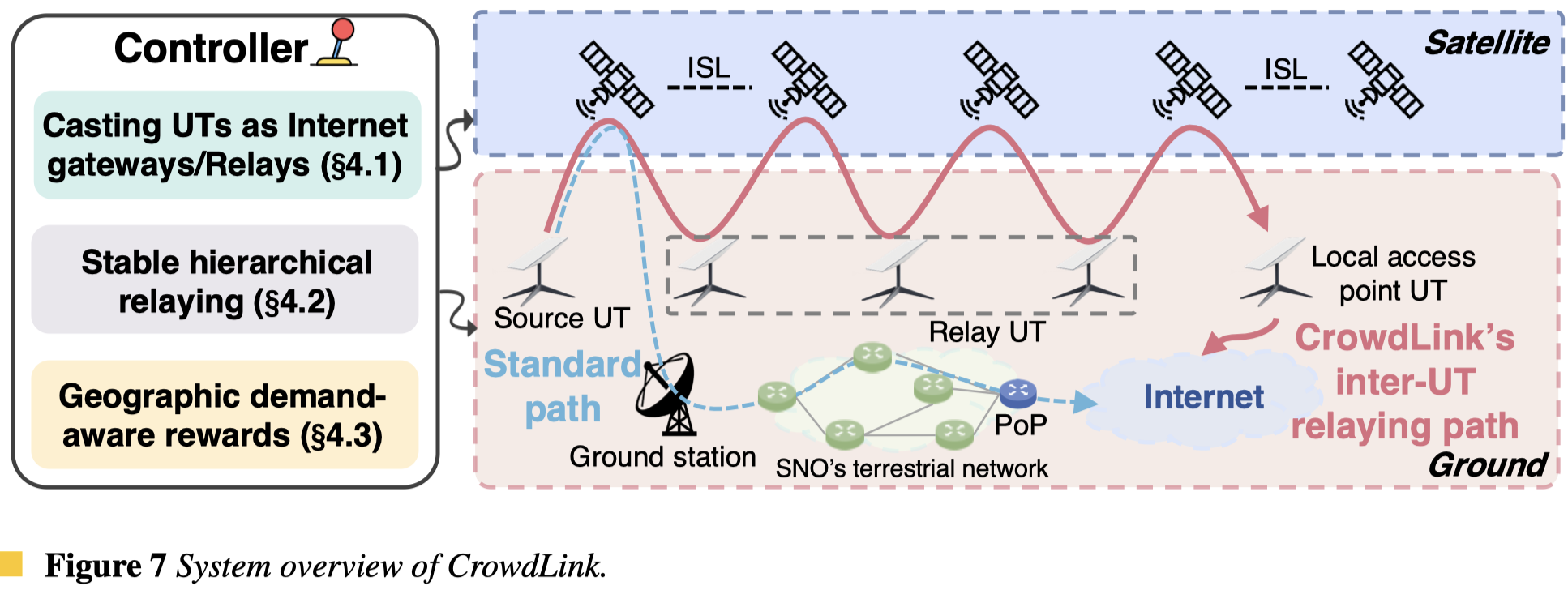
CrowdLink 作为现有 UT 和运营商连接控制器之上的覆盖网络(Overlay)运行。如 Figure 7 所示,用户终端(UT)可以向控制器注册成为本地接入点(网关)或中继节点
当普通 UT 请求额外的带宽或更低的延迟时,控制器会从资源池中为其分配这些网关/中继节点,规划路径,并在事后进行流量计费与奖励
4.1 将 UT 改造为互联网网关与中继
为了以极低的成本实现平滑部署,CrowdLink 对现有软硬件进行了巧妙的复用:
- 轻量级端云升级:
- 在用户端,通过纯软件升级,利用 UT 已有的以太网/Wi-Fi 接口作为本地网关,或利用其备用波束(原本用于卫星切换)作为连接多颗卫星的星间中继
- 在云端,复用现有的波束调度算法来统筹这些备用波束
- 对卫星透明的隧道转发:
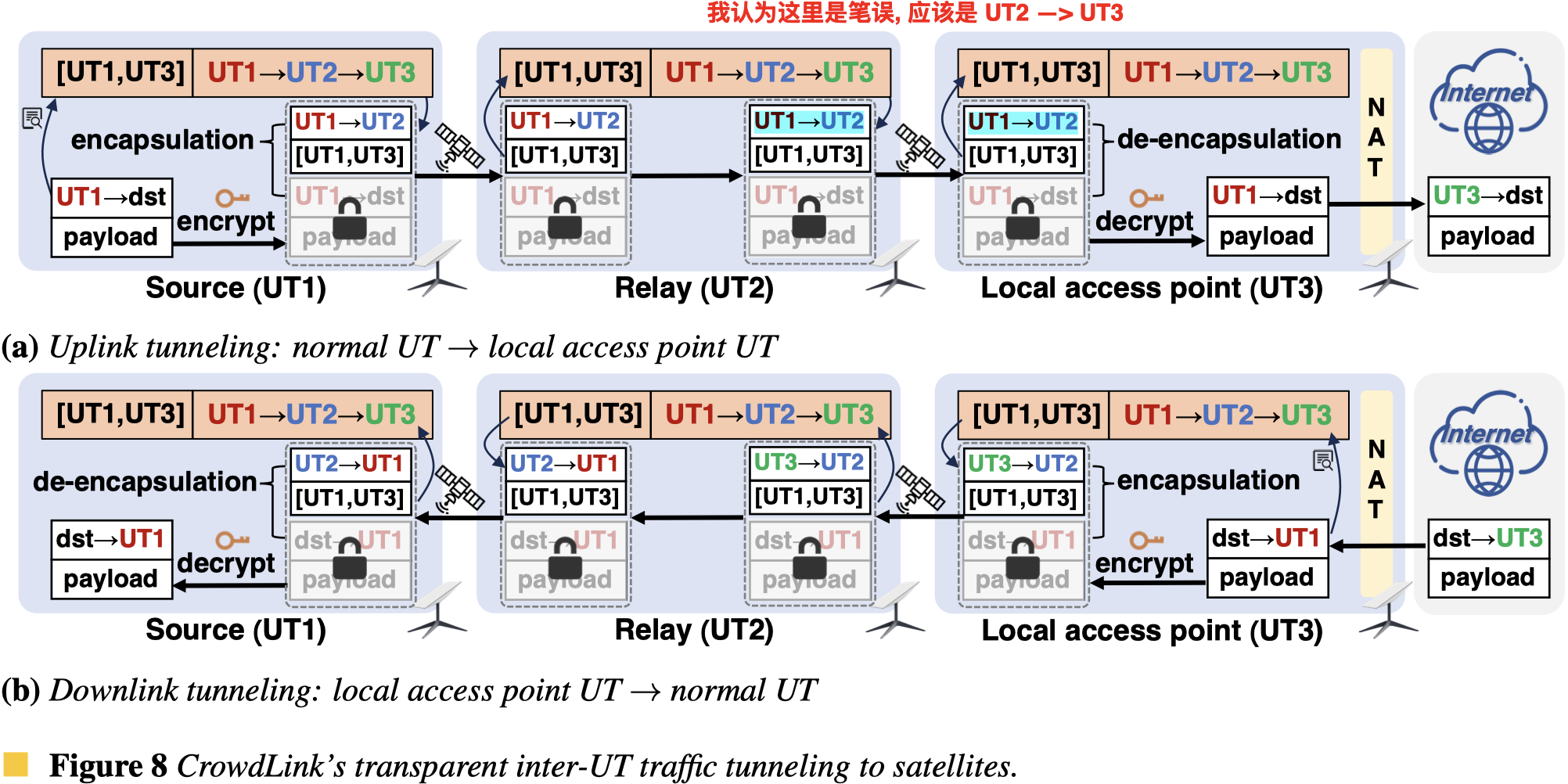
- 数据的转发完全基于 UT 构成的覆盖网络,对上层的卫星网络完全透明。如 Figure 8a(上行) 和 Figure 8b(下行) 所示,数据包会在源 UT、中继 UT 和网关 UT 之间进行逐跳的封装、修改路由头和解封装
- 安全与隐私保护:
- 针对不可信的私人 UT 节点,系统采用了端到端加密隧道(将流量引导至运营商的 PoP 节点)、可选的洋葱路由封装
- 以及基于用户性能反馈的异常节点剔除与惩罚机制
4.2 稳定的分层 UT 间中继路由
为了解决 LEO 卫星极速移动导致的链路频繁断开和路由雪崩问题,CrowdLink 利用 UT 相对静止的特点构建了稳定的逻辑拓扑:
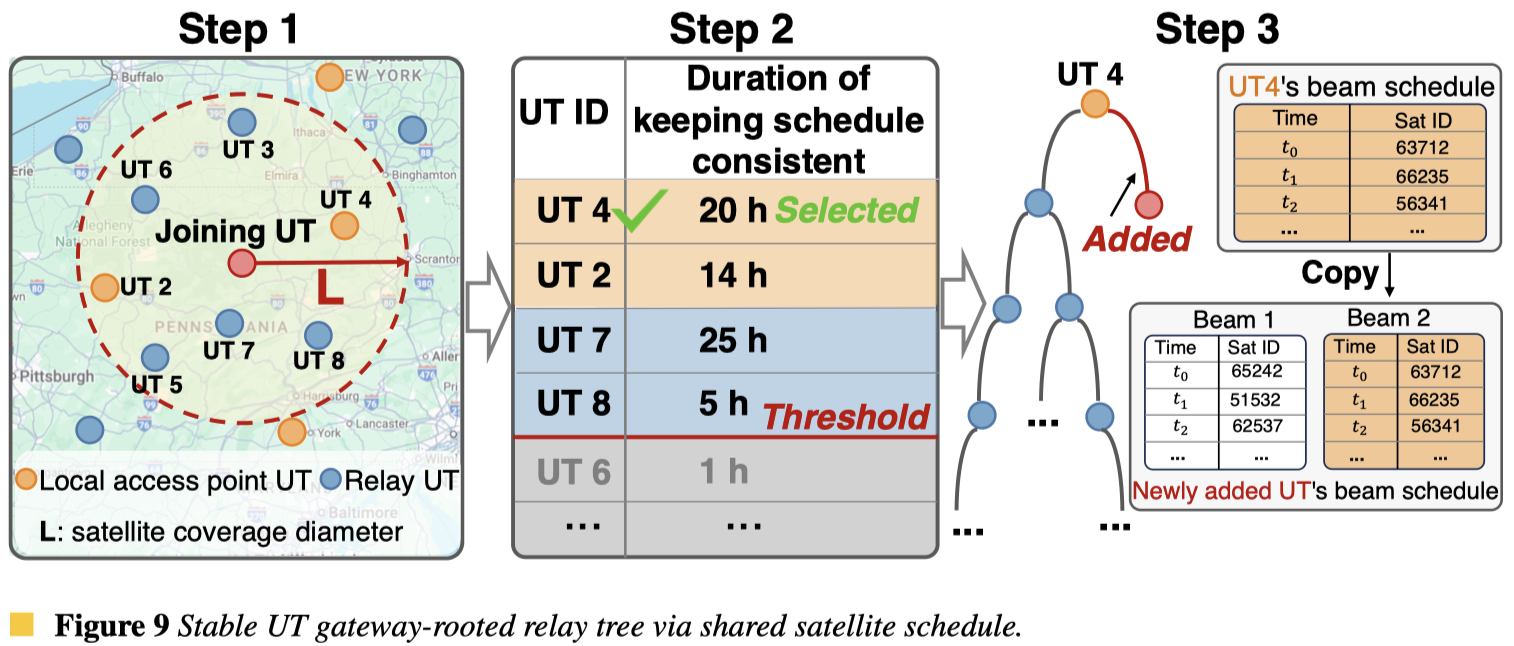
- 构建以网关为根的中继树 (Schedule Replication):如 Figure 9 所示,新加入的 UT 会通过三步接入网络
- 在卫星覆盖半径内发现上游候选父节点
- 评估候选节点的负载与时间表一致性
- 核心操作:子节点完全复制父节点的卫星接入时间表
- 这意味着它们会始终同步连接到同一颗卫星,从而使 UT 之间的逻辑链路保持长期稳定
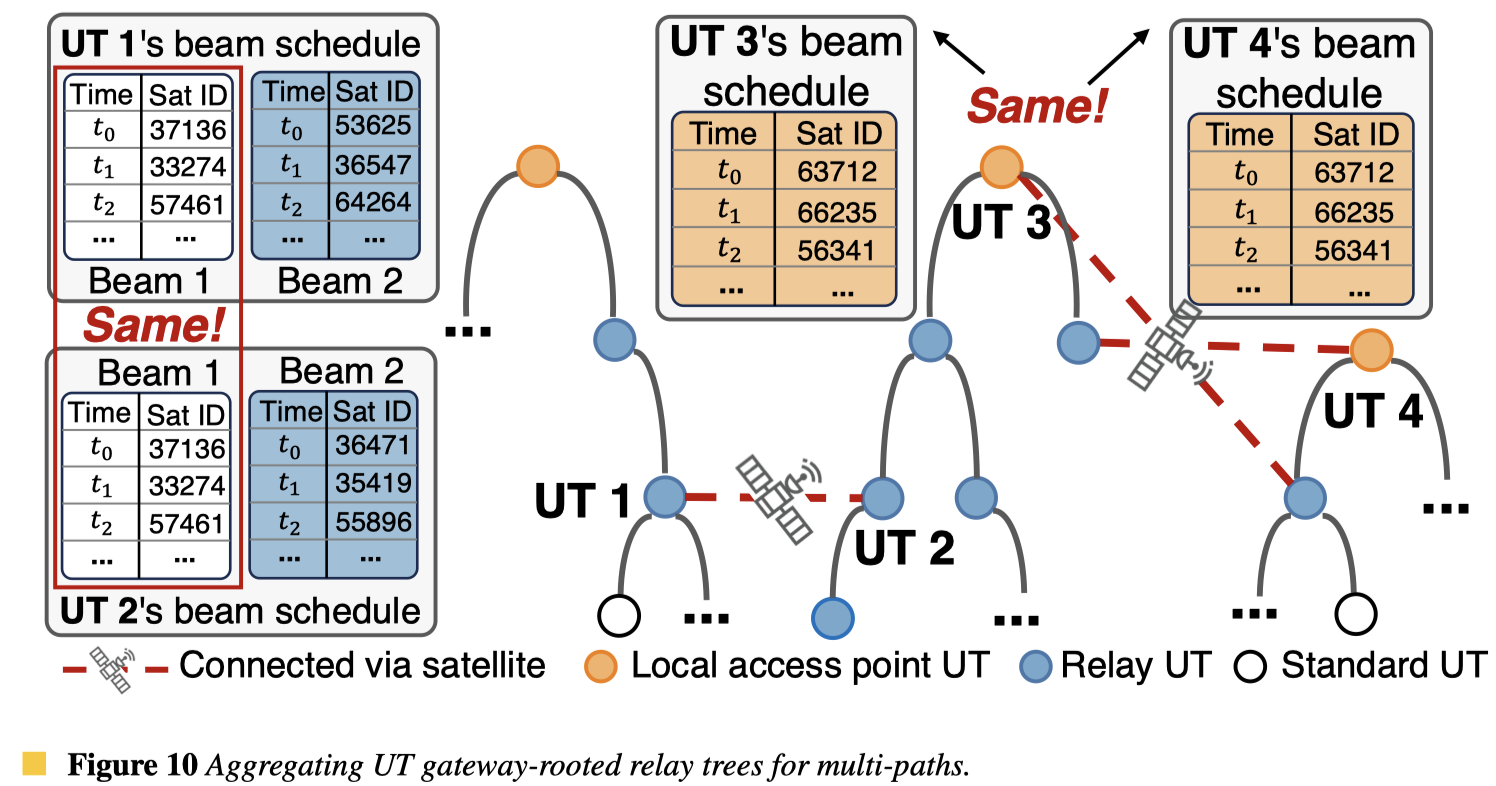
- 跨树聚合支持多路径:
- 如 Figure 10 所示,为了打破单个网关的带宽瓶颈并实现负载均衡,控制器会将不同的“网关树”相互交织连接,为普通 UT 提供多条到达不同网关的可选路径
- 分层路由计算:
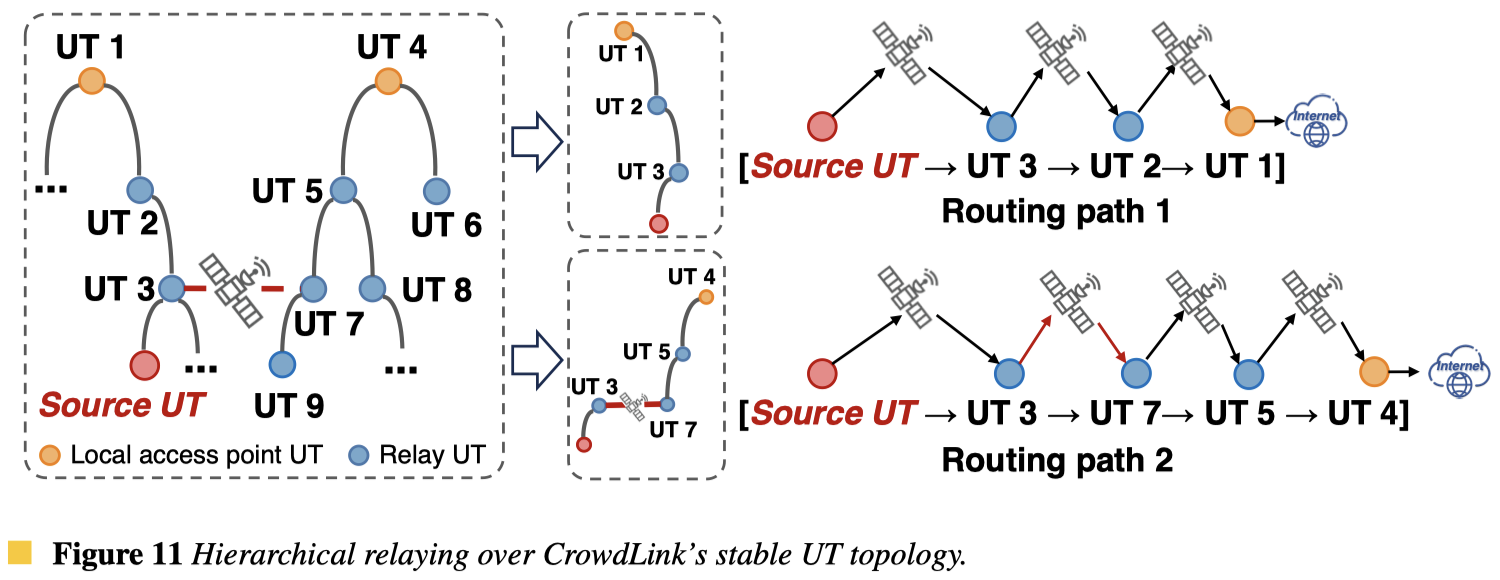
- 如 Figure 11 所示,基于上述稳定的树状拓扑,路由计算就退化为了简单的自底向上遍历操作
- 由于底层拓扑是稳定的,大大降低了控制器重新计算路径和下发信令的开销
4.3 感知地理供需的 UT 奖励机制
为了鼓励用户开放自己的设备资源,系统设计了一套结合 P2P 理念的经济激励模型:
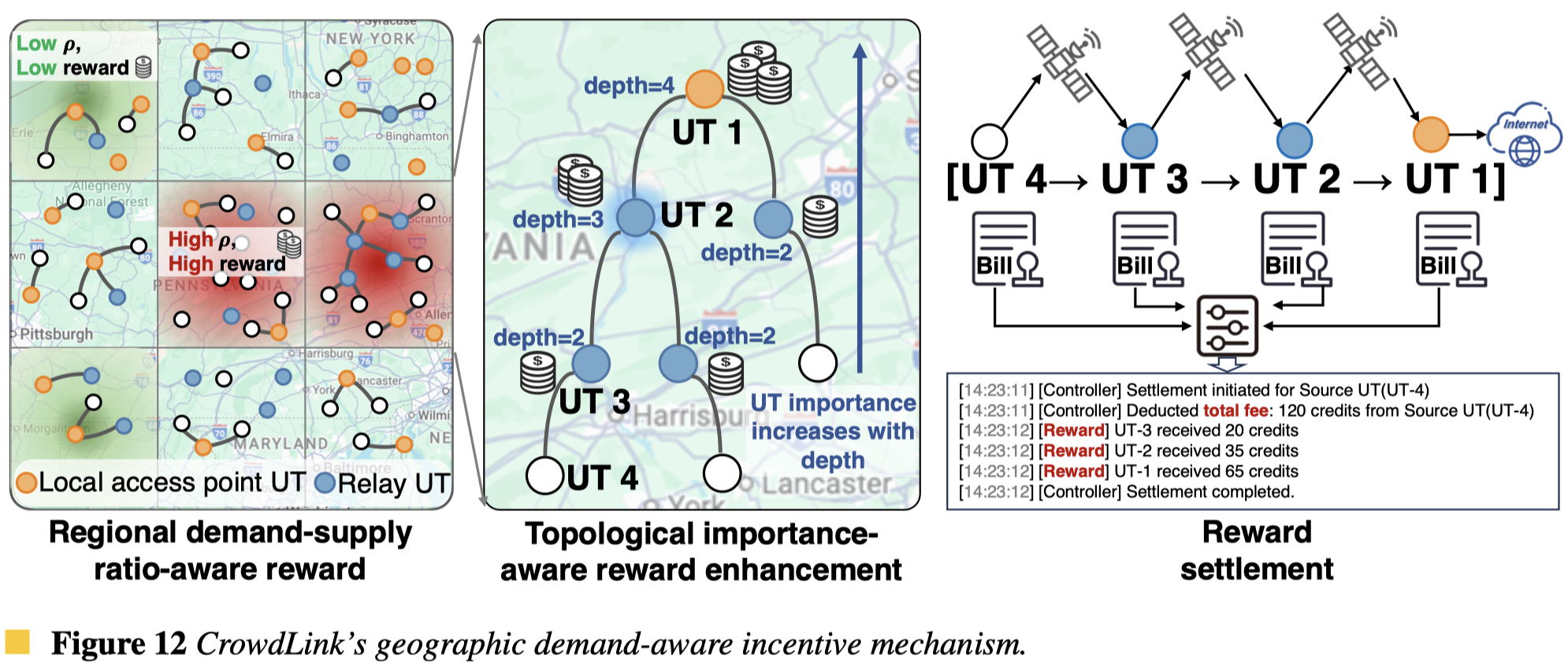
- 动态区域定价:
- 控制器会实时计算局部区域的“供需比”(由源 UT 的带宽请求量与当前活跃网关/中继的可用容量决定)
- 当某个区域需求旺盛 or 卫星运力严重闲置时,该区域的奖励单价自动上浮,反之下降
- 拓扑重要性加成:
- 除了基础流量费用,处于关键路由枢纽位置(例如路径更深、连接了更多普通用户的稀缺中继节点)的 UT 会获得额外的奖励乘数加成
- 可验证的计费结算:
- 参与转发的数据流会在各节点进行轻量级记账并生成密码学签名
- 在每个计费周期结束时,这些凭证被统一提交给控制器,用于生成对普通用户的账单以及对网关/中继用户的奖励
Proof-of-Concept Prototype¶
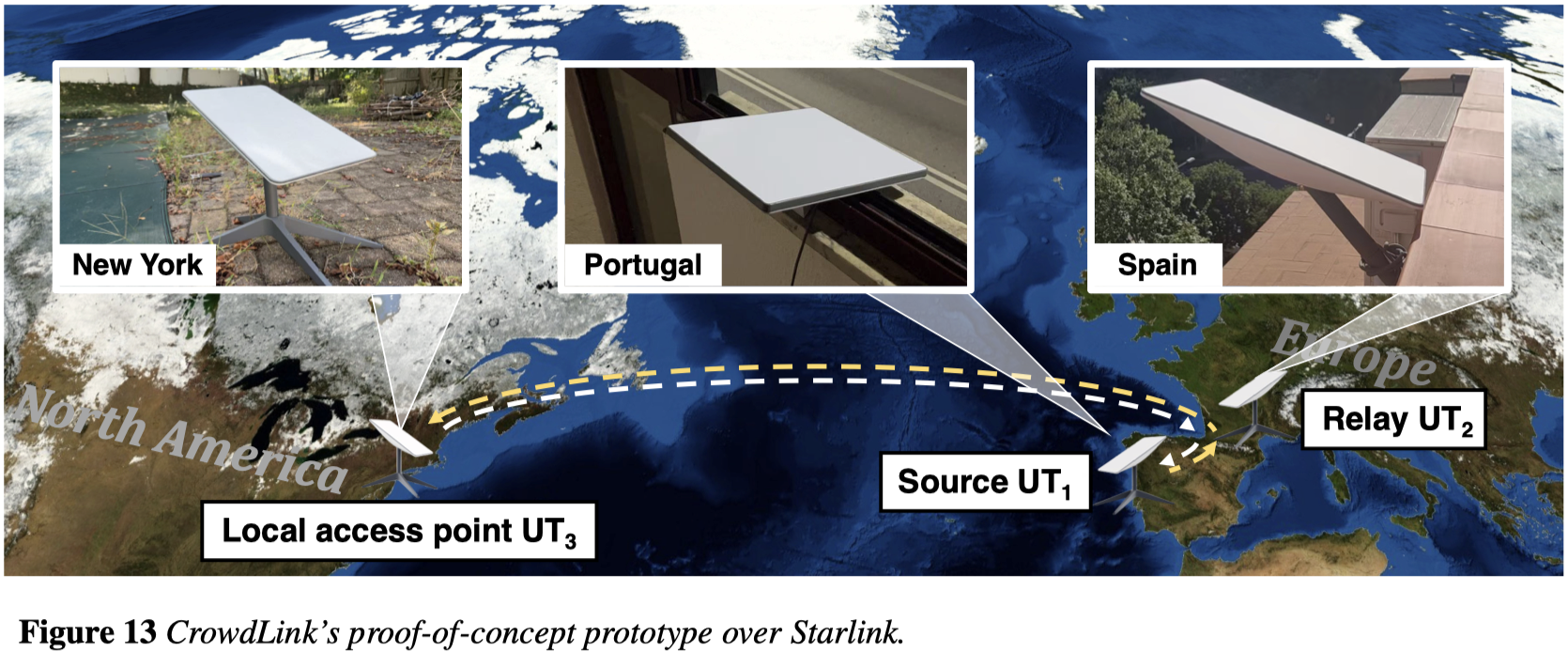
(1) 非侵入式的设计理念
为了在当前最大的 LEO 商业网络(Starlink)上验证其实用性,团队采用了一种非侵入式的原型设计
作为第三方,研究团队无法直接访问 Starlink 的网络基础设施或修改其官方终端(UT)固件
因此,他们在每个 Starlink 终端(Dishy)后方串联了一台商用主机(Host),由该主机来执行所有的 CrowdLink 功能
这种方式无需修改任何卫星硬件,且对底层卫星网络保持完全透明
(2) 对卫星透明的数据面(UT 端主机)
每台 UT 后方的主机负责执行 CrowdLink 的数据面逻辑 。它利用 Linux 的 netfilter/iptables 工具拦截出站数据包
处理流程:
- 源 UT 主机拦截数据包并进行端到端加密(如采用 AES-128 算法保障隐私与完整性)后进行封装
- 中继 UT 主机接收后进行解封装、修改路由并重新封装转发
- 最后,本地接入点(网关)主机进行解封装,并将原始数据包通过其地面宽带接入真实的互联网
在整个过程中,天上的卫星仅作为“透明的数据传输通道”,完全感知不到下方 UT 之间正在进行中继通信
同时,主机端还会记录每一条流的流量,为后续计费提供支持
(3) 控制面逻辑: 中心化控制器
控制器部署在集中的地面服务器上
它负责接收服务请求,为用户分配网关和中继节点,并在稳定的 UT 拓扑上计算分层中继路径并分发给对应的 UT
在每个计费周期结束时,控制器还会收集各 UT 带有签名的流量记录,据此生成账单和奖励结算
(4) 真实世界跨国部署配置
团队在真实环境中部署了三套 Starlink Dishy 设备(及对应主机)进行跨国实测
角色分配:位于葡萄牙的设备作为普通源用户(Source UT),位于西班牙的设备作为中继节点(Relay UT),位于纽约的设备连接互联网作为本地接入点网关(Local access point UT)
Conclusion¶
This paper presents CrowdLink, a user-assisted solution to LEO network underutilization. CrowdLink aims to eliminate the last-mile bottlenecks and LEO satellite wastes induced by the skewed distribution of ground stations. Its key idea is to reuse user terminals as decentralized Internet gateways and relays for underutilized satellites, converting their idle links into complementary paths for more network capacity. This paradigm is self-scaling to massive users and satellites, mutually beneficial for them, and incrementally deployable in operational LEO networks. A key lesson from CrowdLink is that end users can play a valuable role in scaling, simplifying, and boosting the satellite network. We hope CrowdLink can inspire efforts for scalable and efficient Internet from space for the users, and by the users.
(1) 核心目标与定位:
CrowdLink 被定位为一个基于用户辅助的解决方案,其主要目的是消除由于地面站分布不均衡所引发的“最后一英里”传输瓶颈,并解决由此导致的低轨卫星资源闲置浪费问题
(2) 核心思想与机制:
核心理念是: 将无处不在的用户终端(UT)重新利用,将其转化为去中心化的互联网网关和卫星中继节点
这相当于把未充分利用的闲置卫星链路转化为了额外的网络补充路径,从而直接提升了整个网络的容量
(3) Inspiration:
本文的关键启示是,终端用户可以在扩展、简化和提升卫星网络性能方面发挥极具价值的作用